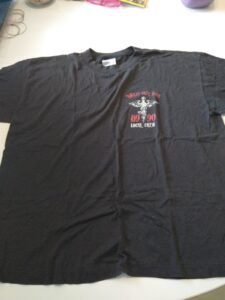
How a piece of the 1990 Dr. Feelgood tour ended up on a dollar rack in St. Augustine, Florida.
I saw Mötley Crüe several times during their heyday. I was there for Theatre of Pain, Girls, Girls, Girls, and Dr. Feelgood. I watched Tommy Lee play his drums upside down over the audience. I met Mick Mars at a hotel after a show. I’ve owned enough Mötley Crüe merchandise over the years to make a small museum out of it.
Which, come to think of it, is pretty much what I’m doing now.
But one of the most interesting Mötley Crüe shirts I own didn’t come from a concert. I didn’t order it from Rockabilia, find it on eBay, or pay some collector an outrageous amount of money for it.
I bought it for one fucking dollar at a thrift store.
And it wasn’t just any Mötley Crüe shirt.
The Dr. Feelgood Years
I saw Mötley Crüe on the Dr. Feelgood tour at Joe Louis Arena December 1st 1989, and March 17th 1990, at the Palace of Auburn Hills.
By then, Mötley Crüe had become one of the biggest rock bands in the world. The venues were enormous. The stage productions were outrageous. And Tommy Lee was still finding new ways to do things behind a drum kit that no reasonable human being should attempt.
I bought merchandise that night. One of my favorite purchases was a medical scrub top with the Dr. Feelgood design on it.
It was perfect for that album. The whole medical theme worked beautifully on an actual scrub shirt. Unfortunately, mine eventually developed a hole after an unfortunate incident involving a joint.
I’ve looked for another one since. Good luck with that.
Anyway, fast-forward about twenty-five years.
I’m living in St. Augustine, Florida. I walk into a thrift store and start browsing the used T-shirts.
Nothing particularly exciting. Just another rack of old clothes that somebody doesn’t want anymore.
Then I notice a little logo on the pocket of a shirt.
It’s that familiar Dr. Feelgood design.
My first thought is that somebody’s donated a medical shirt. That isn’t an unreasonable assumption. The design was inspired by medical imagery, after all.
But something isn’t quite right.
I look again.
MÖTLEY CRÜE. LOCAL CREW.
Holy shit.
Not a Concert Shirt. A Crew Shirt.
Now, here’s something you might not know about concert merchandise.
When a major band comes to town, there’s a whole army of people involved in making that show happen. The touring crew travels with the band, but the local venue also supplies workers to help load equipment, assemble the stage, handle production, and tear everything back down afterward.
For some tours, those local workers received special shirts identifying them as crew.
These weren’t shirts you could walk up to the merchandise stand and buy.
And unlike the tour shirts purchased by fans, crew shirts weren’t always treated as collectibles.
People wore them to work.
They got dirty. They got ripped. They got beer spilled on them. They got thrown in closets and forgotten. Most probably ended up in the trash.
That makes surviving examples particularly interesting.
And here I am, standing in a thrift store in St. Augustine, looking at what appears to be a local crew shirt from the Dr. Feelgood era.
For one dollar.
I bought it immediately.
Twenty-Five Years Later
What I find especially funny about this shirt is the timing.
I saw that tour in Michigan in 1989 and 1990. A quarter-century later, I’m living more than a thousand miles away, and a piece of merchandise associated with that same tour practically falls into my lap.
I have no idea where this particular shirt came from.
Maybe someone worked a Florida show. Maybe a crew member moved here from somewhere else. Maybe it changed hands half a dozen times before it ended up in that thrift store.
I can’t tell you which concert it originally belonged to.
And I’m not going to invent a story about that just to make it more valuable.
What I can tell you is where I found it, what I paid for it, and why I recognized it when somebody else might have walked right past.
That’s enough of a story for me.
What’s It Worth?
I was looking through eBay recently, searching for that elusive medical scrub shirt, when I came across another Dr. Feelgood local crew shirt.
The seller wanted $250.
Does that mean mine is worth $250?
Fuck if I know.
Somebody asking $250 for a shirt doesn’t mean anybody’s going to pay $250. I’ve seen vintage shirts sitting on eBay for years at prices that apparently nobody wants to pay.
But that’s part of why I’m building EatNails.
I’m not particularly interested in collecting shirts just so I can list them on eBay and wait for somebody to come along with a credit card.
I want to document them. I want to photograph them. I want to tell you where they came from, or at least what I actually know about them.
And yes, I want to sell them.
Some will be expensive. Some will be cheap. Some will be priced at whatever it takes to convince me to part with them.
But the story doesn’t disappear when the shirt sells.
Because somewhere out there, somebody once wore this thing while working a Mötley Crüe concert.
Twenty-five years later, somebody donated it to a thrift store.
And I bought it for a dollar.
That’s rock-and-roll history, too.
From the EatNails Underground Archive. Real shirts, real stories, and fifty years of music memorabilia. Every item has a history, even when nobody knows the whole thing.